by Madelyn Stanley
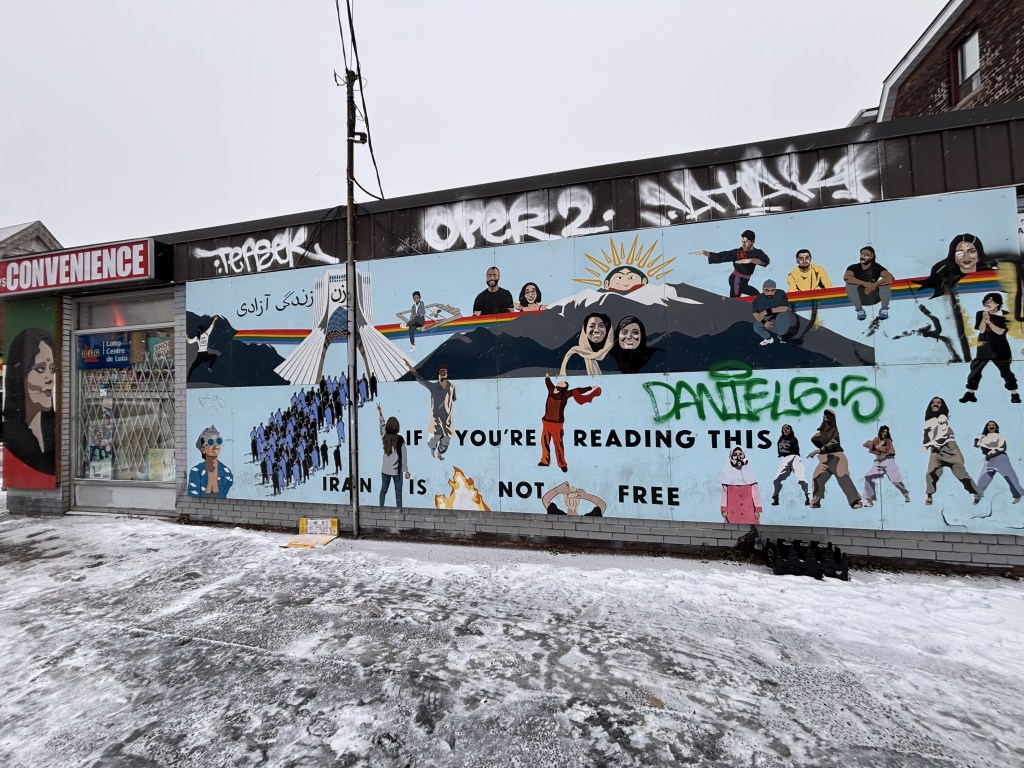
The mural “If you’re reading this Iran is not free,” (pictured above) found in Toronto’s Koreatown challenges simplistic representations of women’s and girls’ resistance in Iran by using alternative and creative forms of defiance. Dominant and narrow understandings of resistance that are prevalent in North America not only limit who we imagine as political actors, but also limit what we imagine as their methods of resistance. Specifically, these representations of resistance often exclude the methods of defiance in which young women engage. This mural in Toronto defies such exclusive understandings of resistance by centering Iranian girls as prominent political actors as they engage in alternative forms of resisting Iran’s oppressive and gendered political regime using social media and dancing. Having this mural in Toronto, Canada’s largest city, exposes several Canadians to these alternative and inclusive representations, raising awareness and allowing for these girls’ to be recognized.
Depicted on the bottom right corner of the mural is a group of teenage girls from Ekbatan, Tehran who, in 2023, recorded themselves dancing in crop tops and without headscarves to the popular song “Calm Down,” by Rema and Selena Gomez. By showing their hair and dancing in public, both of which are prohibited in Iran, these girls seized their bodily autonomy, defying a regime that strictly controls women’s bodies. Upon the video’s release, the girls were detained by authorities for two days and had to record a video apologizing for their actions. Online, their video went viral, set off a TikTok trend, and hashtags were created to show support (#DanceForIran, #SaveTheEkbatanGirls). The trend prompted women and girls from around the world to post videos of themselves dancing in solidarity with the Iranian girls. This instance of resistance demonstrates how girls find creative and radical ways to reach global audiences when engaging in political struggle. The reference to these women on the streets of Toronto helps redefine and expand Torontonians’ notions of Iranian young women’s resistance.
The girls in the Toronto mural demonstrate how dancing is a form of political resistance, challenging our conceptions of what qualifies as effective methods of resistance. These girls demanded that normative understandings of political struggle in Iran be expanded to include artistic methods of resistance. Mainstream media mostly relies on overt and clearly defined moments of defiance through the mass-mobilizations of marches and protests. These forms and images of resistance dominate and overshadow other methods of resistance that then go unrecognized. Farzaneh Milani argues that through poetry and fiction, female writers have found ways to assert their narratives despite the constraints of the regime, which highlights how Iranian women use artistic expression to amplify their voices (1992). The girls in the video used creative methods to defy a state that removes women’s physical autonomy and ability for self-expression. They danced to show their bodies, not as sites of patriarchal oppression and coverture, but as sites for artistic and political expression, enacting bodily autonomy. While dancing is an effective tool for self-expression, these Iranian teenage girls wield it as a powerful act of political resistance.
The mural also challenges who we understand to be political actors and how we engage in resistance using online media. The everyday realities of young people, and especially young women, under the Iranian regime do not occupy space in mainstream media. Likewise, their political voices and agency are oftentimes overlooked and therefore deemed less legitimate. Through their online dance, these Iranian teenage girls showcased a different facet of resistance, one where creativity and youth drive political and artistic engagement, reaching the masses despite the oppressive regime. Young people use social media to gain widespread recognition of their struggle, encourage global solidarity, and prompt trends. Palestinian scholar, Nadera Shalhoub-Kevorkian, argues that while cyberspace can be a dangerous space of surveillance, domination, data-extraction and patriarchal ideologies, it is also a place where young people find community, and display their creative skills and everyday life (2011). While it is important to be wary of the negative implications of social media, this mural demonstrates how Iranian teenage girls used online platforms to showcase their struggle for liberation; they were able to access larger audiences, heightening their own voices using dance and cyberspace. The mural’s depiction of these girls challenges narrow definitions of resistance, broadening Torontonians’ notions of Iranian defiance by highlighting overlooked political actors and their unconventional methods of resistance.
Madelyn Stanley is a third-year student at the University of Toronto majoring in philosophy. Her main research interests are in feminist and Indigenous ethics and epistemology.
 WGS340 WOMEN & REVOLUTION IN THE MIDDLE EAST