by Yalda Matin
Iranian women have gained vigorous media attention in recent years. The Woman, Life, Freedom Movement (Jin, Jîyan, Azadî [Kurdish]; Zan, Zendegi, Azadi [Farsi]) of 2022 internationalized a reignited resistance within Iran after the murder of Mahsa (Jina) Amini by the Islamic Republic’s “morality police.” The gravity of this movement was recognized by the Nobel Peace Prize committee, who awarded the 2023 Nobel Peace Prize to Narges Mohammadi, a prominent jailed Iranian women’s rights activist. Even before the Women, Life, Freedom protests, the fight for women’s rights in Iran was recognized by the Nobel Peace Prize committee, giving the 2003 award to the Iranian human rights lawyer Shirin Ebadi. The struggle for women’s equality in Iran since the 1979 Revolution has been recognized and celebrated by “the West.” However, the women of the Islamic Republic are not the first Iranian women to organize and lead resistance movements.
The status of Iranian women is often characterized in a binary: idyllic and free under the Shah, and oppressed, veiled, and invisible under the Islamic Republic. This narrative asserts that progress in Pahlavi Iran came from state-led Westernization projects, and that under the Islamic Republic, mandatory veiling and gender segregation moved Iran back in time. This assigns a passivity to Iranian women and minimizes their role in resisting patriarchy. The feminist progress of Pahlavi Iran is then cast as reductive, as the passive adoption of western norms (Afkhami 1994). Ultimately, the role of Iranian women in the struggle for women’s education, suffrage, and family law reform is erased.
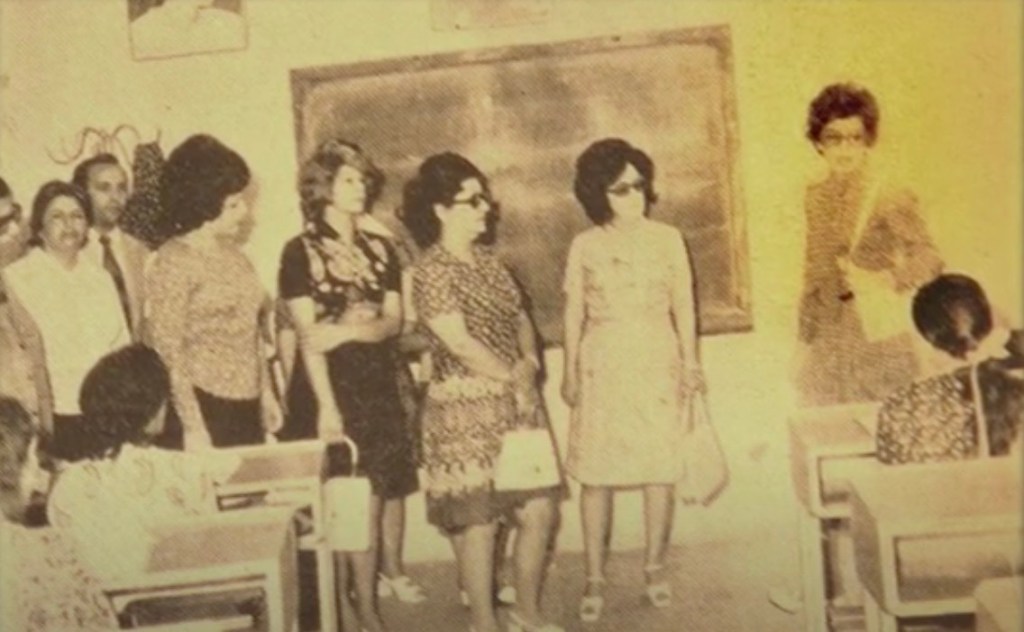
The above image is of a literacy class conducted by the Women’s Organization of Iran (WOI) in the 1970s. Iran’s Minister for Women’s Affairs from 1975-1978 and the WOI’s secretary general from 1970-1978, Mahnaz Afkhami, is seen on the right. The WOI was a national, state-sponsored organization that operated from 1963 to 1979. At its peak, the organization had a million members from across Iran. The women of the WOI took part in an annual general assembly to elect its board of directors and to develop annual plans of action. In 1975, it had 349 branches and 120 family welfare centers across Iran. The role of this organization in Pahlavi Iran directly challenges the popular assumption that the improved status of Iranian women under the Shah was merely “granted” by a modernizing, Western-oriented state. However, each legal change, each funding provision to women’s education, and each social reform was the result of lobbying and organization from this sophisticated and creative women’s movement (Afkhami 2022).
The WOI lobbied successfully for feminist legislation, such as the Family Protection Law of 1967 and 1975. It also made important progress in battling female illiteracy and empowering women economically. As Afkhami explains, the organization provided vocational training to poor and rural women, conducted legal literacy programs, and provided family planning support. The WOI’s family welfare centers provided vocational training in carpet weaving, sewing, typing, and hairstyling to facilitate the entry of low-income women into the labour force. They also provided daycare so that mothers could also enter the workforce. The organization fought for universal childcare and negotiated legislation for maternity leave. The women of the WOI, both its executive and grassroots members, fought for women’s rights in the face of the patriarchal oppression of the ulama (clergy), conservative male politicians, the state, and society (Afkhami 2022).
Similarly, the post-1979 story of Iranian women is not one of simple oppression. Women have negotiated their place within the Islamic Republic, finding avenues to achieve success within the state’s theocratic framework (Ansary 2015). Building on the progress made in women’s education during the Pahlavi Dynasty, Iranian women have steadily increased their prominence in higher education and professional fields, namely STEM fields, and often outpace their male counterparts (Higgins & Shoar-Ghaffari 1994). In a state that places them as second-class citizens, women have resisted the regime’s theocratic gender regime to become doctors, lawyers, and engineers.
As argued by Marnia Lazreg, Western feminist theory is complicit in the continued degradation of non-Western women (2008). It assumes a Western feminist subject, othering Middle Eastern women through labels of religion, culture, and nationality. Non-Western cultures are seen as incompatible with feminist goals, and cultural labels are used as all-encompassing explanations for oppression. The women in the above photo were leaders who worked, collaborated, and negotiated the means of bettering the status of Iranian women. Confining them to a category of inherently oppressed Third World women erases their dynamic feminist activism and places them as “followers” of Western feminism rather than makers of Iranian feminism. This also prevents an understanding of Iran’s diverse history of feminist movements that have creatively navigated highly politicized gender regimes to resist patriarchal gender norms. The Woman, Life, Freedom movement is both built on and continues this history and must be understood in a way that centers Iranian women as agents of their own feminist histories.
Yalda Matin is an undergraduate student studying International Relations and Near and Middle Eastern Civilizations at the University of Toronto. Her research is focused on women’s movements in Iran.
 WGS340 WOMEN & REVOLUTION IN THE MIDDLE EAST