
Course Instructor: Susan Benson-Sokmen (s.benson.sokmen@utoronto.ca)
Special Thanks to Esra Kazanbas, the course’s awesome Teaching Assistant!
COURSE DESCRIPTION
This course is an interdisciplinary examination of the critical and creative crosscurrents of gender and sexuality and resistance in the Middle East. Alongside our examination of the histories, memories, political imagination, creative output, and current practices and struggles of feminist and queer movements in the Middle East, we will trouble simplistic media narratives of the region’s oppression of women and sexual minorities. The class assignments will challenge students to “write against” Orientalist tropes of Middle Eastern repression by helping them explore the region’s historical, economic, political, ethnic, and social diversity. Additionally, students will have the opportunity to publish their research on a class curated open-source website. The class website will, like the course’s themes, readings, and discussions, take students beyond the classroom, encouraging them not only to learn and write about resistance in the Middle East, but contribute to the region’s ongoing struggles for, and imaginations of, social justice, freedom, and liberation.
LAND ACKNOWLEDGEMENT
I acknowledge that I am an educator living and teaching on Indigenous land; land that for thousands of years has been the traditional land of the Huron-Wendat, the Seneca and, most recently, the Mississaugas of the Credit River. Today, this meeting place is still the home to many Indigenous people from across Turtle Island and I am grateful to have the opportunity to teach and live on this land.BI am committed to social justice for all peoples living on these lands. In this class we will make connections between past and present struggles for freedom, equality, and justice in the Middle East and Canada. It is my hope that alongside our exploration of the long history of resistance to colonialism, imperialism, state violence, and dispossession in the Middle East, we will learn more about the struggles for land, liberation, and justice “at home.”
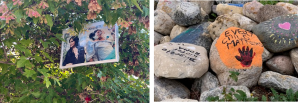
(Left): Remembering the Victims & Survivors of Canada’s Residential School System
(Right): Remembering Jina Amini and other victims of state violence in Iran
COURSE LEARNING FORMAT
“The classroom, with all its limitations, remains a location of possibility. In that field of possibility, we have the opportunity to labor for freedom, to demand of ourselves and our comrades, an openness of mind and heart that allows us to face reality even as we collectively imagine ways to move beyond boundaries, to transgress. This is education as the practice of freedom.”
―bell hooks―
Fostering a Collaborative Classroom:
Your Participation is essential to our success! To that end, classes will function as collaborative seminars. Therefore, I ask you to attend all classes and actively participate in class discussions. To make our learning experience meaningful and intellectually invigorating, please complete readings before class (take notes, jot down questions, come prepared to join the conversation).
The Classroom as a Brave Space:
I see my role in the course as a planner, guide and facilitator of learning, discussion, and rigorous debate. Your active participation in the course as both learners and scholars is essential to our success. While I have planned the course, it is open to modification; your suggestions, concerns, questions, and interests will be used to continually to revise our plan. If you feel that your performance or participation is being impacted by something within or outside of the classroom please reach out to me.
As this is a seminar course you are asked to be co-authors of our discussions. To that end together we will transform our classroom into a “brave space.” Below are some suggestions of how to foster “authentic and equitable” conversation; we will determine the contours of our “brave space” together in the first few weeks of classes:
- Prioritize honesty and authenticity for all
- Discomfort is inevitable and constructive
- Value risk taking, vulnerability, learning, being challenged to reflect
- Safety is subjective and critically inclusive
All forms of racism, Islamophobia, sexism, transphobia etc. will NOT be tolerated. If you want to ask a question/contribute to the discussion but you feel like the words you have to do so may cause harm, let the class know at the beginning of the question or statement and we’ll find different words together as we think through your question or idea. Again, reach out to me (email or office hours or by appointment) if you have any questions or concerns.
In an effort to affirm and respect the identities of transgender students in the classroom and beyond, please contact me if you wish to be referred to using a name and/or pronouns other than what is listed in the student directory.
Course Learning Objectives
To encourage and develop students’ critical and analytical skills in the study of the vibrant histories and current creative practices of gender and queer resistance in the Middle East by:
- Providing students with a variety of anti-colonial, feminist, queer, and Marxist theoretical perspectives and methodological tools…
- Creating opportunities for students to use & “practice” these perspectives and tools…
- Using a variety of assignments to aid students in the honing of their “scholarly voice” (their ability to communicate effectively and persuasively in writing)
COURSE OUTLINE
Week 1: Welcome to WGS340
- Introductions to One Another
- Introductions to Course Themes, Learning Outcomes, Format, Expectations, & Assessments
In Seminar Discussion Exercise: What does respect mean to you? Negotiating and setting our “rules of engagement.”
Background Reading:
- Sensoy, Özlem and Robin DiAngelo. “Respect Differences? Challenging the Common Guidelines in Social Justice Education,” Democracy & Education 22, no. 2 (2014), 1-10.
Section I: Writing & Talking about Women, Gender, Sexuality & Queerness in the Middle East
Week 2: Writing & Talking about Gender & Resistance in the Middle East
Seminar Discussion Readings:
Dirik, Dilar. “A Self-Critique.” The Shedding [blog], (21 November 2024). https://dilardirik.substack.com/p/a-self-critique
Mikdashi, Maya. “How to Study Gender in the Middle East.” Centre for Contemporary Arab Studies News Magazine (3 June 2020), https://ccas.georgetown.edu/2020/06/03/how-to-study-gender-in-the-middle-east/
Week 3: (Mis?) Representations of Gender & Queerness in the Middle East
In Seminar Video: “Nawal El Saadawi: Feminism is not a Western Word.” (https://www.youtube.com/watch?v=qkcrwl8ukms)
Seminar Discussion Readings:
Lazreg, Marnia. “Decolonizing Feminism.” In The Eloquence of Silence: Algerian Women in Question, Second Edition, 6-20. Milton: Routledge, 2008.
Moussawi, Ghassan. “(Un)Critically Queer Organizing: Towards a more Complex Analysis of LGBTQ Organizing in Lebanon.” Sexualities 18, no. 5-6 (2015), 593-617.
Şimsek, Bahar and Joost Jongerden. “Gender Revolution in Rojava: The Voices beyond Tabloid Geopolitics.” Geopolitics 26, no. 4 (2021), 1023-1045.
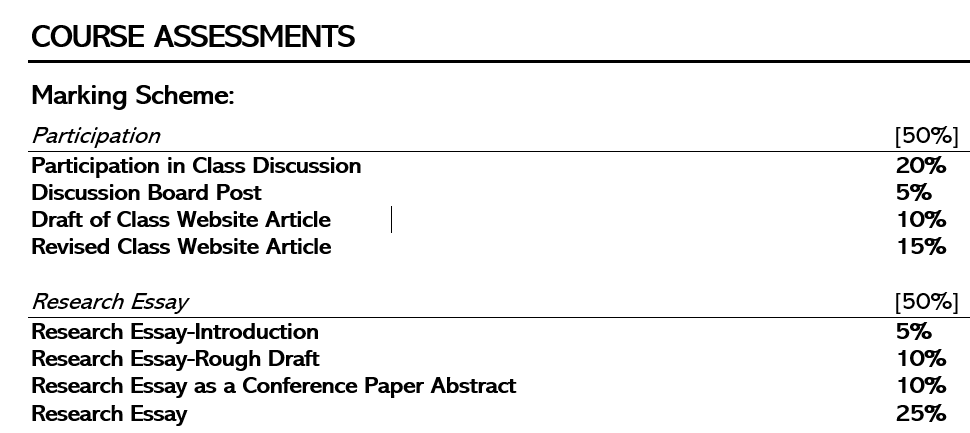
DUE: Discussion Board Post
Week 4: Histories & Memories versus (Simplistic) Representations of Women & Resistance in the Middle East
Seminar Discussion Readings/Podcast:
Hale, Sondra. “Memory Work as Resistance: Eritrean and Sudanese Women in Conflict Zones.” Comparative Studies of South Asia, Africa and the Middle East 32, no. 2 (2012), 429-436.
Zaatari, Zeina. “Women’s Movements in the Middle East: From Feminist Consciousness to Intersectional Feminism and Everything In Between.” In Handbook on Women in the Middle East, 221-251.Edited by Suad Joseph and Zeina Zaatari. New York: Routledge, 2023.
Ayad, Nahlah [Host]. “The Stolen Revolution: Iranian Women of 1979.” CBC Ideas. 8 March 2019. https://www.cbc.ca/radio/ideas/the-stolen-revolution-iranian-women-of-1979-1.5048382.
Section II: Theories, Histories, & Experiences of Violence & Resistance
Week 5: Colonialism, Occuption, & Resistance (from Palestine)
In-Seminar Reading: “No end in sight to the ‘war on women’ in Gaza.” UN News (18 July 2024). https://news.un.org/en/story/2024/07/1152246)
Seminar Discussion Readings:
Adbulhadi, Rabab. “Israeli Settler Colonialism in Context: Celebrating (Palestinian) Death and Normalizing Gender and Sexual Violence,” Feminist Studies 45, no. 2 (2019), 541–73.
Shalhoub-Kevorkian, Nadera. “E-Resistance among Palestinian Women: Coping in Conflict-Ridden Areas.” The Social Service Review 85, no. 2 (2011), 179-204.
Stedler, Mikki. “Other Scenes of Speaking: Listening to Palestinian AntiColonial-Queer Critique.” Journal of Palestine Studies 47, 3 (2018), 45-61.
DUE: Draft of Class Website Op-Ed
Week 6: Violence, Memory, & Revolution (from Algeria)
First Hour: Library Workshop on Copyright Permission & Research Methods
Second Hour: Discussion of Readings
Seminar Discussion Readings:
Sohrabi, Naghmeh. “Writing Revolution as If Women Mattered.” Comparative Studies of South Asia, Africa, and the Middle East 42, no. 2 (2022), 546–50.
Surkis, Judith. “Ethics and Violence: Simone de Beauvoir, Djamila Boupacha, and the Algerian War.” French Politics, Culture and Society 28, no. 2 (2010), 38-55.
Vince, Natalya. “Being Remembered and Forgotten.” In Our Fighting Sisters: Nation, Memory and Gender in Algeria, 1954-2012, 212-251. Manchester: Manchester University Press, 2015.
DUE: Research Essay-Introduction
Reading Week: No Class
Week 7: Women & Armed Struggle (from Kurdistan)
Seminar Discussion Readings/Film:
Diyar, Zilan. “The Whole World is Talking About Us.” (translation of “Vakit Geldi” from Yeni Özgür Politika, posted on The Kurdish Question on 23 December 2014).
Jiyan’s Story. Directed by A. Halûk Ünal. Real Stories. 2017. https://www.youtube.com/watch?v=oEQEidgcMhU&t=2s.
Sarican, Elif. “Sakine Cansız: Women’s Liberation and the Kurdistan Freedom Movement.” In She Who Struggles: Revolutionary Women Who Shaped the World. Edited by Marral Shamshiri and Sorcha Thomson. London: Pluto Press, 2023.
DUE: Class Website Op-Ed
Week 8: Violent Intimacies (from Turkey)
In Seminar Video: “My Name is Happy.” (https://www.youtube.com/watch?v=OiOR-GEIQAY)
Seminar Discussion Readings:
Atuk, Sumra. “Feminicide and the Speaking State: Woman Killing and Woman (Re)making in Turkey.” Journal of Middle East Women’s Studies 16, no. 3 (2020), 283–306.
Zengin, Asli. “Introduction: Violent Intimacies.” In Violent Intimacies: The Trans Everyday and the Making of an Urban World, 1-36. Duke University Press: Durham, 2024.
Section III: Pushing Against Nation Borders & Disciplinary Boundaries
Week 9: Popular Culture & Resistance
In Seminar Video: “The queer revolution in the Middle East: ‘One good song can do more than 5,000 protests.’” (The Guardian, https://www.youtube.com/watch?v=_DQYwBhgOxk&t=15s)
Seminar Discussion Readings:
Cooke, Miriam. “Introduction.” In Dancing in Damascus : Creativity, Resilience, and the Syrian Revolution, 1-20. New York, NY: Routledge, 2017.
El-Nabli, Nadine. “’Lakum ‘Adatkum Wa-Lana al-Musiqa’: A Critical Engagement with the Politics of Identity, Resistance and Affect in Mashrou` Leila’s Music.” British Journal of Middle Eastern Studies 48, no. 1 (2021), 114–29.
Pratt, Nicola. “Popular Culture, Gender, and Revolution in Egypt.” Journal of Middle East Women’s Studies 17, no. 1 (2021), 137–46.
DUE: Research Essay-Draft
Week 10: Discursive Deployments
In Seminar Video: “Kismet: How Soap Operas Changed the World.” (Al Jazeera, https://www.aljazeera.com/program/witness/2014/1/15/kismet-how-soap-operas-changed-the-world/)
Seminar Discussion Readings:
Chamas, Sophie, and Sabiha Allouche. “Mourning Sarah Hegazi: Grief and the Cultivation of Queer Arabness.” Women’s Studies Quarterly 50, no. 3 (2022), 230– 49.
Hasso, Francis, “Discursive and Political Deployments by/of the 2002 Palestinian Women Suicide Bombers/martyrs.” Feminist Review 81 (2005), 23-51.
İbrahimhakkıoğlu, Fulden. “‘The Most Naked Phase of Our Struggle’: Gendered Shaming and Masculinist Desiring‐Production in Turkey’s War on Terror.” Hypatia 33, no. 3 (2018), 418–33.
Week 11: Present Tensions?
Seminar Discussion Readings:
Ali, Zahra. “Feminisms in Iraq: Beyond the Religious and Secular Divide.” Gender and Research 20, no. 2 (2019), 47-67.
Ghaderi, Farangis and Ozlem Goner. “Why “Jîna”: Erasure of Kurdish Women and Their Politics from the Uprisings in Iran.” Jadaliyya (1 November 2022). https://www.jadaliyya.com/Details/44560
Khalid, Maryam. “The Peripheries of Gender and Sexuality in the ‘Arab Spring.’” Mediterranean Politics 20, no. 2 (2015), 161–77.
DUE: Research Essay-As a Conference Paper Abstract
Week 12: Transnational Solidarities
Seminar Discussion Readings:
Salem, Sara. “On Transnational Feminist Solidarity: The Case of Angela Davis in Egypt.” Signs: Journal of Women in Culture and Society 43, no. 2 (2018), 245–67.
Shamshiri-Fard, Marral. “The Gendered Politics of Dead Bodies: Obituaries, Revolutionaries, and Martyrs Between the Iranian, Palestinian, and Dhufar Revolutions.” In The Fate of Third Worldism in the Middle East: Iran, Palestine and Beyond, eds. Rasmus C. Elling and Sune Haugbolle. One World Academic: London, 2024.
DUE: Research Essay
 WGS340 WOMEN & REVOLUTION IN THE MIDDLE EAST